 The SemOps Manual
13. Operate and consume
Part III — The practice · SemOps stages 7–9 · Operating-model layers 1 and 6
Stories answered here As a platform owner, I want the same checks that guard the repository to run against what is actually in the triple store. As a data owner, I want to share a graph without sharing every predicate in it. As an application developer or an agent, I need documentation of what the terms mean and a guarantee they will not change under me.
A scientific article comes with its metadata kept somewhere else: the category, the authors and their institutions, the place and date of publication. For each of those you lift the pen and go and look somewhere else. A knowledge graph built on RDF with resolvable identifiers is not like that. The metadata is more graph, and you can follow it without lifting the pen. Some years ago I called this the Möbius-strip approach to information architecture, because metadata and data end up on the same surface.
I mention it here because the last three pipeline stages are where that idea either pays off or doesn't. Runtime validation, observability and consumption are where a knowledge graph earns its keep or quietly becomes a cost centre. It is also where this toolchain's coverage is thinnest, and this chapter is explicit about which parts are real and which are grey.
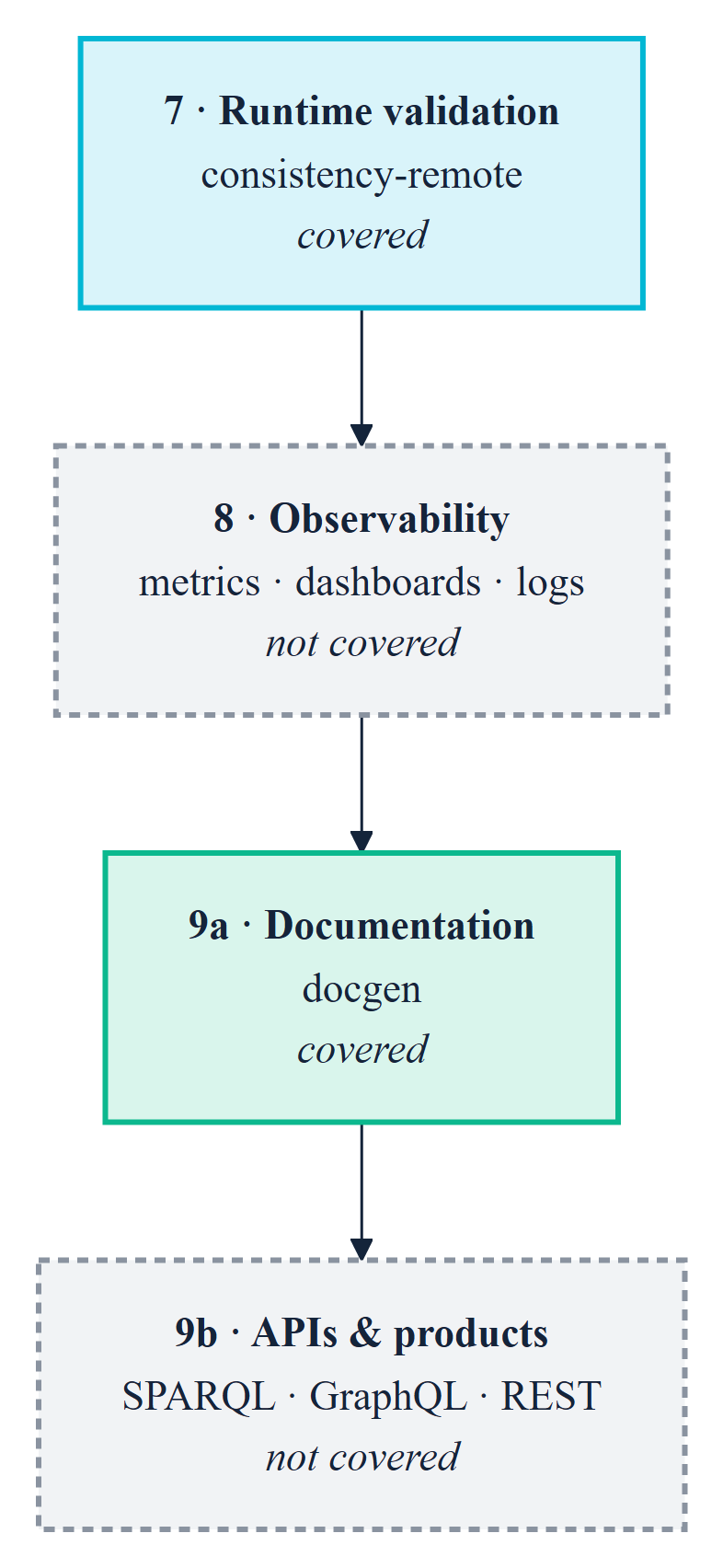
One thing has moved since the last edition, and it does not fit neatly on that diagram because it cuts across all three stages: access policy enforced by the store itself, from HOLOS's holosdb package (§13.2). It is early, and it is the most interesting addition to this part of the pipeline.
13.1 Runtime validation against a live store
Everything so far has run against files in a repository. The moment the org chart moves from Git-tracked Turtle into a real store, a new question appears: is what is actually loaded still consistent with what we think we shipped?
Repository checks cannot answer that. A store drifts through partial loads, manual fixes, an update applied to one environment and not another, or a graph someone forgot to reload.
# the store: HOLOS's server, from the HOLOS release
holos-server --listen 127.0.0.1:7878 --store ./var/acme

python -m ontology_suite consistency-remote \
  --query-endpoint http://127.0.0.1:7878/query \
  --manifest graphs.json \
  --out-dir out/consistency-remote --fail-on-anything
The store here is the toolchain's own, holos-server, but the command speaks the plain SPARQL 1.1 Protocol, so any endpoint will do. --auth-user and --auth-password are there for stores that want HTTP basic authentication.
graphs.jsonis not bundled with the fixture, and cannot be. Unlike every other command in Part III, this one has no runnable file to point at, because a manifest binds your store's named-graph URIs, which nobody else can know. You write it once, as below.
The manifest is the interesting part
A store holds triples, not project metadata. Nothing in it links a named graph back to the transformation query that produced it, or a data graph to the ontology graph it is supposed to conform to. The manifest is where a project records that binding. It is a short JSON file:
{
  "graphs": [
    {
      "graph_uri": "https://acme.example.org/graph/ontology/2.0.0",
      "role": "ontology"
    },
    {
      "graph_uri": "https://acme.example.org/graph/triplified/employees",
      "role": "triplified_data",
      "source_tarql": "queries/employees.rq",
      "ontology_graph_uri": "https://acme.example.org/graph/ontology/2.0.0",
      "notes": "nightly load from the HR extract"
    }
  ]
}| Field | Applies to | Meaning |
|---|---|---|
graph_uri |
both | The named graph's URI as the store knows it |
role |
both | Exactly "ontology" or "triplified_data"; no other value means anything |
source_tarql |
data only | Local path to the query that produced this graph |
ontology_graph_uri |
data only | Which "ontology" graph this data must conform to |
notes |
both | Free text; ignored by the tooling, read by humans |
Or build it in Python, which is worth doing if the URIs come from somewhere programmatic:
from ontology_suite.remote.manifest import GraphManifest, GraphBinding

GraphManifest(bindings=[
    GraphBinding(graph_uri="https://acme.example.org/graph/ontology/2.0.0",
                 role="ontology"),
    GraphBinding(graph_uri="https://acme.example.org/graph/triplified/employees",
                 role="triplified_data",
                 source_tarql="queries/employees.rq",
                 ontology_graph_uri="https://acme.example.org/graph/ontology/2.0.0"),
]).save("graphs.json")
That structure enables a genuine three-way check: the live data graph, the ontology graph it claims to conform to, and the local query file that produced it, compared together. It catches the specific and common failure where the repository is perfectly consistent and the store is a version behind: the ontology renamed a class, the query was repaired, CI went green, and nobody reloaded the data. The data graph then still uses the old class, which the ontology graph no longer declares, and the template and the live data disagree about it. --fail-on-anything makes that a non-zero exit.
--sample-limit caps how many triples are pulled per named graph, which is what makes this viable against a production-sized store. And remember Chapter 12's rule here too: if the ontology graph holds only your own file and not the vocabularies it imports, terms such as foaf:name will be reported as undeclared. Load the imports into a graph the manifest lists.
Finding out what your graph URIs actually are
The manifest must use the store's own URIs, not what you think you loaded. Ask the endpoint:
SELECT ?g (COUNT(*) AS ?triples)
WHERE { GRAPH ?g { ?s ?p ?o } }
GROUP BY ?g ORDER BY DESC(?triples)
Run that first, every time, against a store you did not load yourself. A graph URI that differs by a trailing slash is the commonest reason a three-way check reports nothing at all.
rolewas not validated, and a typo cost you the whole check. Up to 0.23.0 a manifest saying"triplified-data"(a hyphen instead of an underscore) loaded without complaint, contributed zero data bindings, and the run completed successfully having compared nothing. It exited 0 even with--fail-on-anything: a typo in a config file reading as a clean bill of health. It was the same silent-zero shape as the--own-namespacenear-miss in Chapter 9 §9.4 and the shapes-lessshaclrun in Chapter 11 §11.1.From 0.24.0 the manifest is refused when it loads, naming every bad role in the file at once together with the valid set. On 0.24.0 itself that refusal arrived as a Python traceback rather than a one-line error -- the shape §7.4 complains about -- and 0.24.1 reports it as one line on stderr, exiting 2 as a usage error rather than 1 as an uncaught exception. The exit is non-zero on both, which is the part a gate reads.
The defence is still worth keeping on any version, because it is the general answer to this shape and not to this one flag: point the check at a graph you know is wrong, once, and watch it complain.
Named graphs are a decision you make once
Chapter 3 argued that per-partner named graphs are the highest-value cross-boundary decision, and this is where it pays off. The manifest model assumes named graphs. A store where everything was merged into the default graph cannot express these bindings at all, and cannot answer "which supplier asserted this?" either. tarka's --graph option makes per-source graphs the path of least resistance at load time, and they are effectively impossible to retrofit.
But SHACL validation itself does not see them. SHACL is defined over one data graph, and the engine behaves accordingly: quad syntaxes (TriG, N-Quads) parse fine, and every named graph plus the default graph is merged into a single graph before validation. So named graphs give you provenance and lifecycle (which partner sent what, which graph to reload, which to drop) and they do not give you scoped validation. If you need "validate supplier A's contribution against supplier A's contract", extract that graph and validate it as its own document. The manifest model above is built for exactly that: it binds each graph to the ontology it should conform to, and checks them one at a time rather than as a union.
13.2 Access policy at the scan
The newest thing in this part of the toolchain is a store that answers a query as somebody. HOLOS enforces access policy at the index scan: each quad is decided as it comes off the index, before any SPARQL operator sees it. Not by rewriting the query, and not by filtering the results afterwards.
The property that buys is easy to state and strong: the answer to a query equals the answer that query would have over the part of the store the principal is allowed to see. It holds for every query shape, without anyone enumerating them, because no operator has any other way to reach the data.
Here it is through the holosdb package from PyPI, on HOLOS's small HR example, run for this edition:
from holosdb import Store, Principal, Policy

store = Store()
store.load("hr.trig")

Q = """PREFIX ex: <http://example.com/>
SELECT ?name ?salary WHERE { GRAPH ?g { ?e ex:name ?name
                              OPTIONAL { ?e ex:salary ?salary } } }"""

policy = Policy().deny_predicate("http://example.com/salary", except_role="hr")

store.query(Q, principal=Principal("urn:user:alice"), policy=policy)
# Alice, Bob, Carol, each with no salary
store.query(Q, principal=Principal("urn:user:alice", roles=["hr"]), policy=policy)
# Alice 95000, Bob 88000, Carol 102000
The rows still come back; the column does not, unless you are in HR. (Note the fluent API: each Policy method returns a new policy. Calling them as statements and ignoring the result leaves you with no policy at all, which is a mistake I made on the first attempt and would rather you didn't.) The places where a query-rewriting design leaks do not leak:
| You ask | You get |
|---|---|
COUNT(*) of salaries, without the role |
0: the aggregate counts the visible store |
| Which named graphs exist, with a graph labelled at level 3 and no clearance | The labelled graph is missing from the list, and so is the fact that it exists |
The same, with Principal(..., clearance=3) |
All three graphs |
The salary query with .fail_closed() on the policy |
A HolosError saying access denied by policy, instead of a silent filter |
All verified at 0.26.0. HOLOS measures the cost at 8 ns per quad, about 1% of decoding the quad. The holos query command from the release takes the same policy as flags (--deny-predicate … --except-role hr, --label-graph, --fail-closed) and gives the same answers.
fail_closed deserves a sentence of its own. Filtering is the default because the filtered answer is the correct answer for that principal. But a compliance report or a reconciliation total that is silently partial will be read as complete, and for those the right behaviour is to fail. Choose per use, deliberately.
Three reasons this matters for SemOps, rather than only for security:
- It moves an element off the grey list. Semantic Governance & Access Control has been "partial: evidence yes, access control no" in every edition. Roles, attributes and classification levels now exist, enforced by the store you embed. Approval workflow still does not.
- It answers the commercial-sensitivity problem in Chapter 3. A consortium member can share a graph without sharing the predicates that reveal their segmentation, and the policy holds for every query a partner could write.
- It gives agents an identity. An agent should be a principal with roles, not a service account that sees everything (Chapter 5).
holosdb also validates: Store.validate("shapes.ttl") returns a dictionary such as {'conforms': False, 'violations': 1, 'engine': 'adapted', 'results': [...]}, and from 0.23.0 results holds each result, with its focus node, path, value, severity, constraint component, shape and message. Its native engine refuses a shapes graph that uses anything beyond SHACL Core (sh:sparql, for instance) with a HolosError naming the construct, rather than dropping the constraint and answering conforms. That refusal is the right one (Chapter 11).
Two things to know before you validate a store you care about. Up to 0.21.0, validation wrote the shapes into the store and left them there, in a named graph of their own (urn:holos:python:shapes from Python, urn:holos:shapes from the command line with --store). Each further call added another copy, because a shape's blank nodes are fresh every time, so two people missing a required name gave 2 violations, then 4, then 6. On a persistent store the copies survived a restart. Building this edition's evidence found it, and 0.21.1 fixed it the same day: the shapes are now read in a scope that is always rolled back, so the store is exactly as it was afterwards. A shapes graph an earlier version left behind is reported, with the DROP GRAPH that removes it, rather than read or dropped on your behalf. If you validated a persistent store with 0.21.0, validate it once with 0.21.1 and read the note.
The other was smaller: up to 0.21.1 the holos validate command defaulted to the native engine and the Python method to adapted, so the same words could run different validators. From 0.22.0 both default to adapted.
13.3 Documentation as a product: docgen
SemOps lists documentation as a first-class element ("without it, semantic systems become opaque"), and it is the artefact Chapter 2 nominated as the answer to the priesthood problem.
python -m ontology_suite docgen \
  --ontology examples/acme_robotics/acme-org-v1.ttl \
  --ref examples/acme_robotics/reference_vocab/org.ttl \
  --ref examples/acme_robotics/reference_vocab/foaf.rdf \
  --out-dir out/docgen
Wrote out/docgen/ontology_doc_data.json: prefix='acme', 4 classes,
2 object properties, 3 datatype properties, 1 sections,
5 external terms (3 resolved).You get a self-contained ontology-documentation.html (class and property tables, diagrams, one concise-bounded-description diagram per class) plus ontology_doc_data.json, the machine-readable version. That JSON is easy to overlook and is the more strategically useful of the two: it is what you feed a documentation portal, a catalogue, or an agent that needs to know what your terms mean (Chapter 5). The --ref vocabularies are read, so foaf:Person and org:OrganizationalUnit carry their upstream definitions into the page; terms with no --ref are listed as external and unresolved, which is the honest outcome.
Still open: the page is reshuffled on every run
Re-checked at 0.24.1: three identical runs, three different files. The content is canonical; the order of the class, property, import and section lists is not. The cause is below docgen. rdflib holds triples in a set, and Python randomises string hashing per process, so the parser hands the extractor its triples in a different order each time (Chapter 14 §14.4 traces it). rdflib still does the parsing even though it no longer evaluates anything, which is why the engine move left this alone.
That matters more for documentation than it would elsewhere. A reference page exists partly to answer "what changed this release?", which is unanswerable when every run reshuffles it. And two colleagues generating the page from the same commit are handed the vocabulary in a different reading order.
If you generate the page in CI, set PYTHONHASHSEED=0. Re-verified: two runs, one hash. It is a workaround, not the fix (the fix is to sort on the way out, ideally into document order), but it costs one environment variable. The same variable turns out to decide whether the DL reasoner can load FOAF (Chapter 14 §14.4), so set it for the whole job rather than for this step alone.
Make it automatic
The maturity model expects documentation "auto-generated on every commit" at Level 3. That is one CI step:
- name: Reference documentation
  env:
    PYTHONHASHSEED: "0"        # until docgen sorts its own output
  run: |
    uv run ontology-quality-suite docgen \
      --ontology ontology/acme-org.ttl --out-dir docs/reference
- uses: actions/upload-pages-artifact@v3
  with:
    path: docs/reference
Documentation that regenerates itself stays true. Documentation maintained by hand was true once.
13.4 Observability: not covered
SemOps stage 8 wants graph size and growth metrics, query-performance dashboards, SPARQL log analysis, data-quality KPIs, provenance tracking and anomaly detection. None of this is in the toolchain. Prometheus, Grafana and Loki remain the right answers, exactly as the pipeline blueprint says.
There is one thing worth doing that costs almost nothing, and it is the bridge between what you have and what you need:
Every check run writes
full_results.csv. Retain them, timestamped.
That file is a time series of your semantic quality. Findings by severity over time, per check id, is a genuine data-quality KPI, and it comes free from artefacts CI is already producing. Since 0.17.0 each row also carries source_file and line, so the series can be cut by file: which module of the ontology is accumulating findings. Most teams delete these with the build.
The signal to watch is not the absolute count but the trend in Warnings. Violations get fixed because they fail the build. Warnings accumulate quietly, and an accumulating Warning count is the observable signature of Chapter 1's decay, visible in your own CI artefacts a year before anyone notices the model has drifted.
13.5 Knowledge products and APIs: not covered
SemOps stage 9 wants SPARQL endpoints, GraphQL and REST APIs, search indexes, and data products. Nothing in the toolchain serves an API, and that is application development rather than quality tooling.
The SemOps material's microservices guidance is the reference here, and its core architectural point is sound: for low-latency semantic APIs, embed the engine in the service rather than putting a service in front of a remote store. That point has gained a candidate from inside the toolchain. holosdb (Python) and holos-wasm / holos-wasm-node (JavaScript) are exactly such embeddable engines, and they carry the access policy of §13.2 with them, so a service built on one answers each caller with what that caller may see.
| Language | Engine | Best at |
|---|---|---|
| Rust | Oxigraph | Highest throughput, lowest latency, mature |
| Python · JS | HOLOS (holosdb, holos-wasm) |
Policy at the scan, RDF 1.2, GeoSPARQL; early |
| Python | RDFLib | Analytics, AI/LLM integration |
| Node.js | Comunica | Streaming, web-native, federated |
| Prolog | SWI semweb |
Rule-heavy, expert-system style |
| Java | Jena / Fuseki | Enterprise-standard, stable |
HOLOS appears in the editor too: the VS Code extension's checks run on holos-wasm-node (Chapter 7). That is not a coincidence so much as a signal: the same embeddable engine can serve the desk and the service.
What consumption demands from everything upstream
Whether the consumer is a React application, a dashboard or an agent, it needs four things, and all four are produced by earlier chapters, not by the API layer:
| Consumer needs | Produced by | Chapter |
|---|---|---|
| Stable IRIs that do not change meaning | Evidence-based semver, migration annotations | 12 |
| To know what a term means | docgen, rdfs:label coverage (QUA-001) |
This chapter, 8 |
| Confidence the data conforms | data, consistency-remote |
10, this chapter |
| To know who asserted what, and what they may see | Named graphs; policy at the scan | 3, §13.2 |
An API built on a graph that lacks these will be wrong occasionally and unpredictably, which is worse than being wrong reliably, because consumers can no longer calibrate their trust.
13.6 Maturity checkpoint
consistency-remote against a live store, plus docgen on every commit, covers part of Level 4's "semantic APIs managed and monitored": the managed half. An embeddable store that enforces access policy adds a piece of governance that was missing, early as it is.
The monitored half needs an observability stack this toolchain does not provide, and Level 4 also expects container deployment, automated environment promotion, and continuous ingestion with retry logic. Those are real gaps, and Chapter 14 is where they are counted honestly rather than glossed.