 The SemOps Manual
9. Continuous integration
Part III — The practice · SemOps stage 3 · Operating-model layer 3
Stories answered here As a SemOps engineer, I want bad semantic changes rejected automatically, and I want the rejection to be about our code.
Have you ever been copied into an email thread that was mostly other people's business? You skim it, you find nothing addressed to you, and after the third one you start filing them unread. Then one day the thread that mattered goes the same way. That, more or less, is how a semantic quality gate dies, and this chapter is about stopping it.
Stage 3 is where SemOps stops being a philosophy. The blueprint's stated goal is blunt, "automatically reject bad semantic changes", and the mechanism is almost embarrassingly simple: one flag, --fail-on, and a non-zero exit code.
The simple part takes a paragraph. The rest of the chapter is about the part that decides whether the gate survives its first month, which is what the gate reports, and to whom.
9.1 The mechanism
python -m ontology_suite ontology \
  --ontology examples/acme_robotics/acme-org-v1.ttl \
  --import-dir examples/acme_robotics \
  --fail-on Violation
--fail-on takes Violation, Warning, Info or never. The command exits non-zero when a finding at or above that severity exists. Against the fixture this exits non-zero, because LOG-001, the deliberate Contractor/Employee contradiction, is a real Violation.
That is the whole gate. version-diff has its own variant (--fail-on major), and consistency, consistency-remote and pattern-consistency take --fail-on-anything. Nothing more exotic is needed for a green or red build.
If you are on 0.23.0 or earlier, those three take
--fail-on-misalignmentor--fail-on-mismatchinstead -- three names for the first flag anyone reaches for. 0.24.0 settled on one and kept the old two as aliases, so a config written either way keeps working.
9.2 The problem: 479 findings
Now run the full registry the obvious way: the whole 61-check catalogue against the ontology, with its real org: and FOAF imports resolved.
python -m ontology_suite checks \
  --ontology examples/acme_robotics/acme-org-v1.ttl \
  --import-dir examples/acme_robotics \
  --engine sparql --out-dir out/checks --fail-on never
Findings: 479 total (55 Violation, 340 Warning, 84 Info)479 every time, and 479 on a new engine. Three consecutive runs give the same count, and so did the runs after the suite moved its evaluation from rdflib and pyshacl onto holosdb and the native SHACL engine. Not one finding moved. That's what you hope for from an engine swap and rarely get.
It has not always been so steady. An earlier edition reported "close to 300" with a drift of 289–298 between identical runs, traced to registry
CONSTRUCTs binding two values per result while the merge step read an arbitrary one. Then the count moved from 301 to 479 with the fixture sitting perfectly still, because the registry grew from 50 checks to 61 and two of the new ones,QUA-009andQUA-010, fire on every undocumented term. A registry upgrade changes your findings while your ontology sits still. Read a jump in the count as "the rules moved" before you read it as "the model got worse".Underneath all of it is §9.8's lesson: a count is a fragile thing to assert on. Through every one of those changes, the set of check identifiers behaved sensibly.
Every one of those findings is real. The suite is genuinely checking every triple in the merged graph, and the merged graph includes the entire W3C Organization Ontology and the entire FOAF vocabulary, complete with their own documentation habits, blank-node axiom style and naming choices.
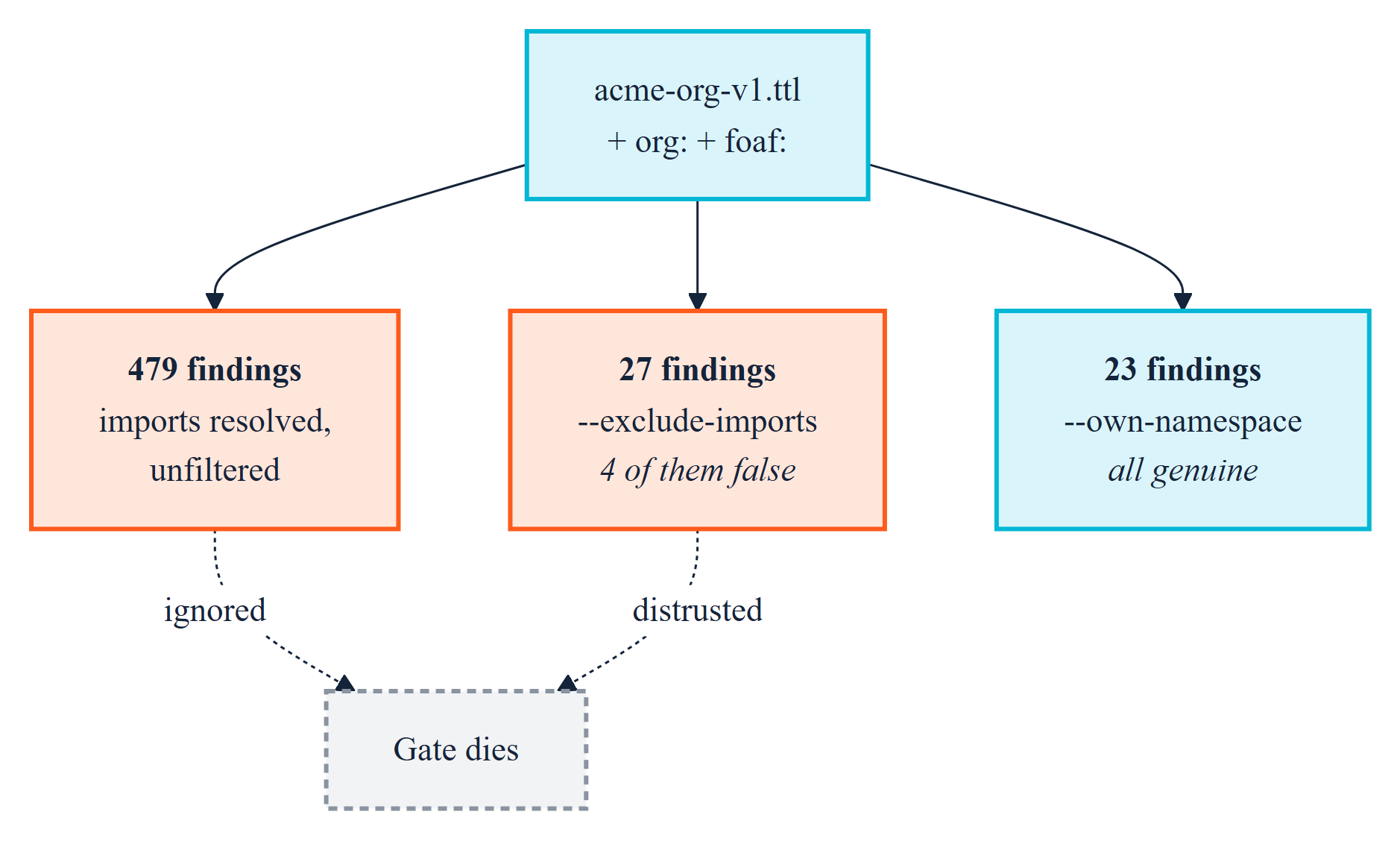
Wire that into CI with --fail-on Violation and you have gated your build on 55 violations, of which exactly one is yours. What happens next is predictable. The team triages it once, concludes the tool is noisy, and either switches the gate off or adds || true. The 23 findings that were genuinely theirs are lost with the other 456.
This is the commonest way a semantic quality gate dies. Not because the checks are wrong (they are not) but because nobody considered Chapter 2's cognitive budget. A gate nobody triages is not a gate.
So: whose problems are these? A domain steward owns the correctness of their own additions to a shared vocabulary. They do not own the W3C's internal documentation habits, and cannot fix them.
9.3 The obvious fix is wrong
The instinctive move is to stop resolving the imports at all:
python -m ontology_suite checks \
  --ontology examples/acme_robotics/acme-org-v1.ttl \
  --exclude-imports \
  --engine sparql --out-dir out/checks_excl --fail-on never
479 findings become 27. Enormously better, and still wrong. Here is the full breakdown:
 2 × DAT-002  Warning    Dangling IRI reference
 1 × LOG-001  Violation  Class disjoint with its own ancestor
 1 × QUA-001  Warning    Class or property missing rdfs:label
 3 × QUA-004  Warning    Resource missing skos:prefLabel
 9 × QUA-009  Warning    Class or property without one skos:prefLabel per language
 9 × QUA-010  Warning    Class or property without a skos:definition
 1 × STR-003  Warning    Property missing both domain and range
 1 × STY-002  Warning    Property name not lowerCamelCase
Inspect the two DAT-002 findings and the cause is immediate:
focus = acme:1.0.0       value = http://xmlns.com/foaf/0.1/
focus = acme:Employee    value = http://xmlns.com/foaf/0.1/Person
Both point at FOAF. acme:Employee is a subclass of foaf:Person, and with imports excluded FOAF is not loaded, so foaf:Person looks like a dangling reference. It is not dangling; it is simply absent. Two of the three QUA-004 findings are the same artefact, against foaf: itself and foaf:Person, whose labels live upstream in a file you just declined to read.
--exclude-imports traded 456 irrelevant findings for 4 false ones. In some ways that is worse. Irrelevant findings get ignored, but false findings get investigated, and an engineer who spends an afternoon proving that acme:Employee is fine learns exactly the same lesson about the tool's trustworthiness.
9.4 The right fix: --own-namespace
Keep the imports resolved, so upstream context is real, foaf:Person genuinely exists and cross-vocabulary reasoning works, and filter the report to findings whose focus node lies in your own namespace:
python -m ontology_suite checks \
  --ontology examples/acme_robotics/acme-org-v1.ttl \
  --import-dir examples/acme_robotics \
  --engine sparql \
  --own-namespace "https://acme.example.org/ns/" \
  --out-dir out/checks_own --fail-on never
1 × LOG-001 Violation Class disjoint with its own ancestor
1 × QUA-001 Warning Class or property missing rdfs:label
1 × QUA-004 Warning Resource missing skos:prefLabel -> acme:hasSkill
9 × QUA-009 Warning Class or property without one skos:prefLabel per language
9 × QUA-010 Warning Class or property without a skos:definition
1 × STR-003 Warning Property missing both domain and range
1 × STY-002 Warning Property name not lowerCamelCaseTwenty-three findings. All twenty-three are Acme's. None are artefacts. Exact across repeated runs, with the same check identifiers every time.
Eighteen of them are the documentation pair, QUA-009 and QUA-010, firing once each on all nine of Acme's terms. The fixture declares rdfs:label on most of them but no skos:prefLabel and no skos:definition anywhere. That is a fair finding rather than noise, and it is a useful shape to recognise: a check that fires on every term is telling you about a policy you have not adopted, not about nine separate mistakes. Decide whether you want SKOS documentation. If you do, it is one pass of work; if you don't, the --registry mechanism in Chapter 8 lets you drop both checks.
Compare the three runs directly. All three are the same ontology, registry and engine:
| Run | Findings | Genuinely yours | Upstream noise | False |
|---|---|---|---|---|
--import-dir alone |
479 | 23 | 456 | 0 |
--exclude-imports |
27 | 23 | 0 | 4 |
--own-namespace |
23 | 23 | 0 | 0 |
Reading the 23 as questions, not as check ids
Twenty-three findings is a list a person can read, but check ids are the tool's vocabulary, not yours. --themes takes a small file mapping check ids to questions in your own words, and puts a by question index at the top of findings.txt:
{
  "Can a domain expert read what each term means?": ["QUA-001", "QUA-004", "QUA-009", "QUA-010"],
  "Is the model logically coherent?": ["LOG-001", "REA-021"],
  "Will our naming survive a code review?": ["STY-002"]
}
-- by question -------------------------------------------------------------
Can a domain expert read what each term means? (20)
QUA-001 x1, QUA-004 x1, QUA-009 x9, QUA-010 x9
Is the model logically coherent? (1)
LOG-001 x1
Will our naming survive a code review? (1)
STY-002 x1
not mapped to a question (1)
STR-003I like this more than I expected to. It turns a report into the start of a conversation with a steward, in the steward's words. And notice the last group: a check with findings that no question covers is listed rather than dropped, so "it found nothing" and "nobody asked" stay distinguishable. The map is many to many, and it belongs to your project rather than to the tool, which is why it is an input rather than registry data.
A real mistake worth repeating
The first time I ran that command, while writing the first edition, I used --own-namespace "http://example.org/acme#" and got:
Findings: 0 total (0 Violation, 0 Warning, 0 Info)A confidently empty report, and at the time indistinguishable from a passing gate. The fixture's namespace is https://acme.example.org/ns/: different scheme, host and separator. --own-namespace is a literal IRI-prefix string match, not a prefix-name lookup.
The tool now says so. Reported from that experience, the same command today prints, before the count:
WARNING: --own-namespace http://example.org/acme# matched none of the 479
findings, so this run reports nothing. It is a literal IRI-prefix match --
check the scheme, host and trailing separator against the ontology's own
@prefix line. Namespaces actually seen: http://purl.org/dc/elements/1.1/,
http://purl.org/dc/terms/, http://purl.org/goodrelations/v1#,
http://schema.org/, http://www.asahi-net.or.jp/~ax2s-kmtn/ (+9 more)
Up to 0.23.0 the first two entries in that list were not namespaces at all but blank-node identifiers with a slash on the end -- N7b108cac662043fa969705589b18d8da/ -- the internal-label leak from Chapter 7 §7.1 turning up in a third place. Harmless, because the real namespaces followed, but the kind of thing a reader squints at.
Fixed in 0.24.0, and worth a sentence on how it survived, because the lesson is this chapter's own. A guard existed to stop it: it tested whether the focus node began _:. But rdflib's blank-node labels carry no such prefix -- they are bare, like N7b108cac... -- so the guard never once fired on real data. It had a test, and the test passed, because the test fed it the string _:0_b56, a shape the suite does not produce. A check you have never seen fail is not yet a check, which is exactly what §9.4 says about the filter itself. The guard now asks the question that matters: a namespace has a scheme, and anything without one cannot be what you meant.
The warning fires only when there were findings to lose. A filter matching nothing on a genuinely clean run is not an error, and warning there would train people to ignore the message. It also goes to stderr, so a CI step that captures only stdout will not show it. Two lessons survive the fix:
- Copy the namespace from the ontology, never from memory. It is the string after
@prefix, in full, including the trailing/or#. - Verify the filter with a known-failing input once, and keep that check. A gate that cannot fail is indistinguishable from a gate that passes.
What the filter could not see, until 0.24.0
One more thing, which I found while preparing this edition and which matters more than the warning. The filter keeps a finding when its focus node starts with your prefix. Most findings are about a term, so that is right. But a few are about the run itself, and they are anchored on a synthetic node, oq:Graph, which is in nobody's namespace. So a scoped run dropped them.
The worst of them was REA-022, "the DL reasoner could not run" -- the finding whose whole job is to say what follows is sound but not complete. A scoped run came back looking complete because that caveat had been filtered out of it. For checks this cost nothing, since checks does not run the reasoner. For data and run, which do, it meant a scoped gate could not tell "HermiT checked and found nothing" from "HermiT never started".
Four other checks were dropped the same way, all of them graph-wide statistics with no natural focus node: EFF-002 (blank-node ratio), STY-005 (mixed local-name separator style), REA-020 (the ontology is inconsistent) and QUA-005. That last one is pointed twice over: QUA-005 fires when an ontology has no identifying IRI at all, and an ontology with no IRI has no namespace of its own to match -- so scoping it dropped the finding that says exactly that.
Suite 0.24.0 fixes this: findings about the run survive the filter. Chapter 10 §10.4 shows the before and after. Three things are worth keeping anyway:
- Know which findings are about the run. It is a real distinction, not an artefact of the bug -- Chapter 4 is built on it -- and it is the one kind of finding you must never filter away.
- On 0.23.0 or earlier, assert on them unscoped. The workaround is in §10.4. Check what you have with
ontology-quality-suite --versionbefore trusting a scoped gate to report the reasoner. - A total is not a check. When this was fixed, the scoped run in §10.4 stayed at 54 findings: it lost a duplicated
LOG-001and gainedREA-022in the same release. A gate watching only the total would have seen nothing change, twice.
When to run the wide pass anyway
Do not discard the wide run; just take it off the pull-request path. Run it periodically, or when an imported vocabulary changes, as an audit rather than a gate. That is when "FOAF published a new version and something in it now conflicts with our assumptions" becomes findable, which is a different question from "did this PR break anything".
| Cadence | Command | Purpose |
|---|---|---|
| Every PR | checks --own-namespace <yours> --fail-on Violation |
Gate |
| Weekly / on upstream change | checks --import-dir … --fail-on never |
Audit |
9.5 Wiring it up
The pattern generalises to three gate types, one per kind of pull request.
name: semantic-ci
on: [pull_request]

jobs:
  ontology:
    runs-on: ubuntu-latest
    env:
      PYTHONHASHSEED: "0"      # docgen's order and the DL reasoner both follow it (Ch. 14 §14.4)
    steps:
      - uses: actions/checkout@v4
        with:
          # version-diff compares against the base branch, so the default
          # shallow checkout is not enough.
          fetch-depth: 0
      - uses: astral-sh/setup-uv@v5
      - run: uv sync --locked      # the suite, holosdb and shacl, at the locked versions

      # 1. Is the schema itself sound?
      - name: Ontology quality gate
        run: |
          uv run ontology-quality-suite ontology \
            --ontology ontology/acme-org.ttl \
            --import-dir lib/vocab \
            --fail-on Violation

      # 2. Does it pass our rules, scoped to terms we own?
      - name: Registry checks (our namespace only)
        run: |
          uv run ontology-quality-suite checks \
            --ontology ontology/acme-org.ttl \
            --import-dir lib/vocab \
            --own-namespace "https://acme.example.org/ns/" \
            --themes ontology/themes.json \
            --engine sparql \
            --out-dir out/checks \
            --fail-on Violation

      # 3. Is this release breaking, and does anything downstream break with it?
      - name: Change impact
        run: |
          git show "origin/${{ github.base_ref }}:ontology/acme-org.ttl" > /tmp/base.ttl
          uv run ontology-quality-suite version-diff \
            /tmp/base.ttl ontology/acme-org.ttl \
            --json --fail-on major --out-dir out/version-diff
        continue-on-error: true   # informational: a MAJOR bump needs sign-off, not a block

      - uses: actions/upload-artifact@v4
        if: always()
        with:
          name: semantic-reports
          path: out/
Five points about that job.
Keep local copies of your imports. --import-dir lib/vocab resolves owl:imports against files in your own repository. --allow-network exists, and CI is the last place you want it. A build whose result depends on a third party's uptime is not reproducible, and an upstream vocabulary that changes silently changes your gate silently.
Pin everything, including the engines. uv sync --locked installs exactly what uv.lock records, and the lock now includes holosdb and shacl because they are runtime dependencies. This is not fussiness. The SHACL engine's 0.3.0 changed the default meaning of sh:conforms to the one the specification defines, under which a Warning or an Info breaks conformance too. The suite responded by pinning shacl>=0.3.0,<0.4, with a comment saying a minor release of the engine can change what a report says. Treat a validator upgrade the way you would treat a compiler upgrade: deliberately, on a branch, with the diff of the reports in front of you.
Pin one more thing, which isn't a package at all: PYTHONHASHSEED. Two behaviours in this toolchain follow Python's per-process hash randomisation: docgen's page order, and whether owlready2 can load FOAF for the DL reasoner (Chapter 14 §14.4). Set it once, at job level. The page order becomes a stable fact, and the reasoner's outcome one that holds nine runs in ten instead of a coin toss on every push, so record which it was rather than assert it.
Upload the reports, and know which one is for whom. Every report-writing command writes one file per audience, and since 0.17.0 no file restates another:
| File | Who reads it |
|---|---|
findings.txt |
A person at a terminal, or an agent: what, where, and the source line. Paste it into the PR |
full_results.csv |
A script: one row per finding, every field, now with source_file and line |
cucumber.json |
A CI plugin: every check as passed, pending or failed |
features/*.feature |
The same, as Gherkin text, one file per category |
report.html |
A browser: summaries, plots, and the first 500 findings |
Six files went in that release: summary_by_category, summary_by_check and top_offenders, each as .csv and .md. Every one was a group-by over full_results.csv, and a search of the suite, its notebooks, its docs and the testing repository found no reader of any of them. If one of your scripts read them, it broke at 0.17.0. (The suite's REPORTS.md dates the change to 0.15.0. The commit history says 0.17.0, and that is the version that matters if you are pinning.)
findings.txt is the one I would hand a reviewer. It quotes each source line once however many checks fired on it, prints a template message once per check rather than once per finding, and gathers the remediations under a single how to fix heading. The suite measured it on the acme run when it landed: 696 lines for the same findings that had taken 1,685 across the old files.
--reports minimal writes only findings.txt and full_results.csv. On a three-finding fixture that is 2 files instead of 20, and 8 KB instead of 334. That suits a gate whose only reader is the exit code, and fixtures that seed one defect each.
cucumber.json is still worth knowing about. Each check becomes a scenario under its category, with Given/Then steps and a pass/fail status, which essentially every CI system's test reporting understands. Semantic quality can then appear on the same dashboard as unit tests without anyone writing an integration. The cucumber_feature and cucumber_scenario fields in a registry entry (Chapter 8) populate it, which is a reason to fill them in on your own house rules.
A MAJOR bump should not block the build. It should demand a human. The job records it and continues; the enforcement belongs in a branch protection rule requiring a named reviewer, which is a governance control rather than a technical one (Chapter 12).
Different PRs need different gates:
| PR touches | Gate to run |
|---|---|
| The ontology | ontology, then checks --own-namespace |
| A transformation query | sketch first; it needs no CSV (Ch. 10) |
| A taxonomy of controlled values | pattern-consistency --output-data (Ch. 12) |
| Data | data, with --sample N if the graph is large, and see §10.4 on scoping |
A gate as a config file
The testing repository carries a small gate.py that reads an ontology-suite.yml and turns it into a run invocation: config file in, exit code out. It is worth copying for one reason above the convenience. The config is where a project writes down, in a reviewable file, which checks it runs and why. Here is its sparql key, abridged:
# Project-local checks *alongside* the suite's own, not instead of them.
registry: competency_tests/results/merged-registry.json
sparql:
  - competency_tests/checks/sparql/competency
  - "@builtin"
In the full file, the comment above those lines tells the story of a gate that reported clean while running eight checks out of fifty, and it sits next to the line that fixed it. That is where such a story belongs.
9.6 The one-command version
Once you know which stages apply, run composes them into a single merged report:
python -m ontology_suite run \
  --ontology examples/acme_robotics/acme-org-v1.ttl \
  --import-dir examples/acme_robotics \
  --queries examples/acme_robotics \
  --own-namespace "https://acme.example.org/ns/" \
  --engine sparql --fail-on Violation --out-dir out
Findings: 26 total (2 Violation, 22 Warning, 2 Info)and it exits 1. The two Violations are LOG-001, the deliberate Contractor/Employee contradiction, and REA-021, from a run where HermiT started.
Up to 0.23.0 that line read 27 total (3 Violation, …), because LOG-001 was reported twice: once from the registry pass over the graph and once from the reasoning pass over its owlrl closure. Each pass deduplicated its own findings, and nothing deduplicated across the join between them, so one contradiction arrived as two rows differing only in which engine found it. Fixed in 0.24.0, which merges across the join and records both routes in the one row's sources. On the fixture it removed two such pairs rather than the one that had been noticed.
That is still fine for a nightly job and still less good as a PR gate, because a single merged pass/fail tells a reviewer less than three named steps that each fail for a stated reason. Prefer the explicit steps where a human reads the result.
9.7 Across the boundary
Chapter 3 noted that the gate has no jurisdiction outside your own organisation. The mechanics are unchanged; what happens to the output is not:
| Internal | Cross-boundary | |
|---|---|---|
| Non-zero exit | Blocks the merge | Generates a notice with a deadline |
findings.txt |
A reviewer reads it | The partner reads it |
| The registry directory | Internal config | A published artefact partners run themselves |
That last row is the highest-leverage cross-boundary move available, and it costs nothing you have not already built. Your check registry is a directory of files, and --registry/--shapes/--sparql mean a partner can point at it and validate before submitting rather than after being rejected.
Run it: notebook 1 — Validation and the gate builds a miniature version of this chapter's fixture and walks the same comparison, including the near-miss filter that returns an empty report.
9.8 Testing the gate itself
Everything so far has used the gate to test an ontology. This section turns it round: how do you know the gate still works?
It is a real question, and the suite's own history answers it. Four times it shipped a check that quietly matched nothing: REA-001 on a bad symmetry assumption, DAT-001 twice (a UNION of FILTER-only branches that matched nothing, and a boolean branch made unreachable because rdflib rewrote the lexical form of an ill-typed boolean), and EFF-002 with an unjoined $this. And this autumn it shipped a check that fired perfectly and said nothing: STY-003, right count, right severity, right focus node, and no message at all on most blank nodes.
A check that cannot fire is worse than no check, because it looks like coverage. It sits in the registry, it appears in the catalogue, it never produces a finding, and everyone concludes that part of the model is clean.
The pattern: a fixture per error category
The practice that catches this is a companion repository of deliberately broken ontologies, each isolating one category of error, each asserting the check identifiers it must trigger. The one described here is public: consolidated-ontology-quality-suite-python-testing, with the fixtures and the harness. Seventeen fixtures, of which a sample:
| Fixture | Seeded error | Must report |
|---|---|---|
01-clean |
(none: the control) | nothing above Info |
03-disjoint-classes |
class disjoint with its own superclass | LOG-001, REA-001, REA-020 |
06-datatype-conformance |
ill-formed xsd:date/integer/boolean |
DAT-001, CNF-003, CNF-004 |
07-naming-style |
snake_case class, untagged label, deprecated term |
STY-001, STY-002, STY-003, QUA-001 |
09-profile-violations |
unionOf, complementOf, minCardinality 4 |
REA-010, REA-011, REA-012 |
14-blank-node-focus |
untagged labels on anonymous restrictions and an owl:Axiom |
STY-003, with a message |
Re-run for this edition against suite 0.25.0, holosdb 0.26.0 and shacl 0.3.4: 166 passed, 10 skipped. The engine move changed none of it; the one test more than the 165 first recorded is one the repository has gained since. No fixture or expectation needed touching, and that is the point of what follows. (To run it yourself you need the suite checked out beside it, which is what it tests, and oxi-gen for the competency tests. Without oxi-gen forty of them stop at setup and say why.)
Assert check identifiers, not counts. This is the whole trick. A regression then shows up as "LOG-004 no longer fires", a named and actionable failure, rather than "expected 85 findings, got 83", which tells you nothing about what broke. It also survives exactly the churn this manual keeps documenting: through a drifting total, a registry that grew by eleven checks and a change of SPARQL engine, the identifiers stayed put.
Keep a clean control. One fixture with no seeded error, declaring its labels, domains, ranges and metadata properly, producing nothing above Info. Without it you cannot attribute findings in the other fixtures to their seeded errors rather than to background noise.
Mark the error in the fixture. Every seeded fault carries an # ERROR: comment naming the check it should trigger, so the fixture documents its own intent:
# ERROR: class local name is snake_case, not UpperCamelCase -> STY-001
# ERROR: no rdfs:label / skos:prefLabel at all               -> QUA-001
:person_record a owl:Class ; rdfs:subClassOf owl:Thing .
Make your fixtures look like real ontologies. This is the one that hurt. Across the first thirteen fixtures there were 101 rdfs:label subjects and not one of them was a blank node. A real ontology is the other way round: most labelled things are anonymous restrictions and axioms. So a check that misbehaved only on blank nodes was undetectable whatever the tests asserted. Fixture 14 exists to fix that. When you write fixtures for your own house rules, ask what the real data looks like, not what is easiest to type.
Five assertions, not one
"Did the expected checks fire?" is the obvious test and the weakest of the five worth writing:
| Assertion | Guards against |
|---|---|
| Expected ids fired | A check silently ceasing to work |
| Forbidden ids did not fire | False positives: a check becoming over-eager |
| Severity ceiling | A finding quietly escalating; the clean control may produce nothing above Info |
| Every finding has a message that names something findable | A check that fires correctly and tells the reader nothing |
| Optional-reasoner ids, asserted only when it ran | A flaky optional dependency turning into a red build |
The second is the one teams skip. Every fixture now carries a forbidden list of ids it could plausibly trip, which is a more useful list than arbitrary unrelated ids. A check that starts firing when it should not is as much a regression as one that stops firing, and it does more damage, because it erodes trust in every other finding in the report.
The fourth is new, and it found a second defect within minutes of being written: EFF-001's message read "(reaching nced07cc7cad44c0499fd01e010fb1164b1)", an internal identifier, on a fixture that had been in the repository all along. Run it with --engine sparql. In the default mode the merge fills a missing message from whichever formulation still has one, so a portable query that has stopped producing messages is hidden.
The fifth is Chapter 4's argument made executable. Findings only a full DL reasoner can produce are asserted only when that reasoner actually ran, and reported as skipped otherwise. An optional dependency that fails a build when it is absent is not optional; one that silently reduces coverage is worse. Skipping, visibly, is the third way and the right one.
One folder per question
The fixtures above are organised by error category. The testing repository now also has a second view, organised by question: 38 competency questions a project asks of its ontology, mappings and outputs, of which 26 the suite can answer, each in its own folder with the smallest data that poses it.
./run-all.sh                  # the board
SUITE=ontology-quality-suite ./run-all.sh   # the same folders, against any install
PASS CT-01-iri-template-drift TQL-001 reported for ?site_IRI -- sites.rq and readings.rq mint the …
PASS CT-21-unit-wrong-for-quantity CMP-021 reported for pressure-R1 -- litres measure volume, not force per unit area.
PASS CT-39-finding-names-something-findable STY-003 reported twice -- once for the anonymous restriction, once for :Chassis.
…
27 green, 0 redRe-run for this edition: 27 green, 0 red, in two minutes. Three things about how it is built are worth borrowing.
Every folder carries the fault and a control in the same files. CT-01's two queries build ?site_IRI from two different templates (the fault) and ?asset_IRI from the same template twice (the control). The script asserts both directions, because a check that fired on everything would pass a fire-only test while being useless.
Each verdict explains itself. "Litres measure volume, not force per unit area." A red row on that board is a sentence a domain expert can read without knowing what CMP-021 is. That is Chapter 2's principle applied to the test suite itself.
Building them taught the authors things about the questions. Fourteen of the 38 can be answered from query text and declarations alone, before a single row of data exists, and a project wanting fast feedback can have 27 answers from artefacts it already holds. And one observation I keep coming back to: trimming each folder to "one defect, one finding" turned out to be impossible in four cases, because several checks are in tension in a minimal model. A class needs a superclass or it is formally undefined, and owl:Thing as that superclass is then a class nothing populates. A clean minimal ontology is not writable. Worth knowing before you read a clean run as proof of anything.
Two practical traps
Test against the library, not the report. The harness imports ontology_suite.pipeline and compares structured result rows rather than scraping report.html. Report formats change (six files disappeared in one release); a test suite coupled to their text breaks for reasons that have nothing to do with the ontology.
A non-zero exit from a broken fixture is success. The CLI exits 1 whenever a Violation is found, so every deliberately broken fixture exits 1: that is the fixture working. Either assert on the findings rather than the exit code, or pass --fail-on never when the exit code is not what you are testing.
The stage decides which checks can fire at all
Worth knowing before you conclude a check is broken: the stages expose different layers, and a check cannot fire in a stage that never runs it.
| Stage | What runs | What cannot fire |
|---|---|---|
checks --ontology |
Registry SHACL + SPARQL over the ontology alone | Conformance (CNF-*), reasoning |
data <file> --ontology |
The full pass: registry, ontology-vs-data conformance, owlrl closure and HermiT |
Nothing, but it is the slowest |
ontology --ontology |
The as-authored evaluation | Everything except profile membership, and that only with --profile |
REA-010/011/012, the OWL2 profile checks, are the sharp case: they fire only from ontology, and only when --profile is passed. A team that runs checks and concludes their ontology is EL-clean has not tested that at all.
It pays for itself
That companion repository surfaced the merge nondeterminism in §9.2, the severity misplacement in Chapter 7 §7.4, the unreachable DAT-001 branch, a crash on language-tagged literals, the namespace legend landing in the project's own namespace, an ontology's default namespace reported as undeclared, --sparql silently replacing the built-in tree, and the EFF-001 message. All are fixed. Taken with its competency board it now pins 58 of the registry's 61 checks; the other three are the extension's alone.
Its COMMANDS.md gives every fixture as both a harness invocation and the equivalent bare CLI command. The experiments/ probes each isolate one defect to about thirty lines, which is a good model for reporting a tool bug you want fixed rather than argued about.
The general form, for your own house rules (Chapter 8): every check you write gets a fixture that makes it fire, a control that must not, and an assertion that the message says something. Otherwise you find out it never did on the day it mattered.
9.9 Maturity checkpoint
A team running these gates on every pull request, with reports retained, is at maturity Level 3, Automated Semantic Delivery, for the validation dimension: predictable releases, faster iteration, early detection of semantic regressions.
Level 3's other dimensions (automated packaging, deployment to dev and test, orchestrated ETL, ingestion monitoring) are partly Chapter 10, partly Chapter 13, and partly not covered by this toolchain at all (Chapter 14).
This is the transition worth spending real effort on. It is also the one that makes agent participation safe: as Chapter 5 argues, a gate that genuinely rejects bad changes is what lets you accept proposals from a much higher-throughput source without accepting the risk that comes with it.